Stop the "Be Everywhere" Trap: How to Turn One Blog Post Into 30 Days of Content

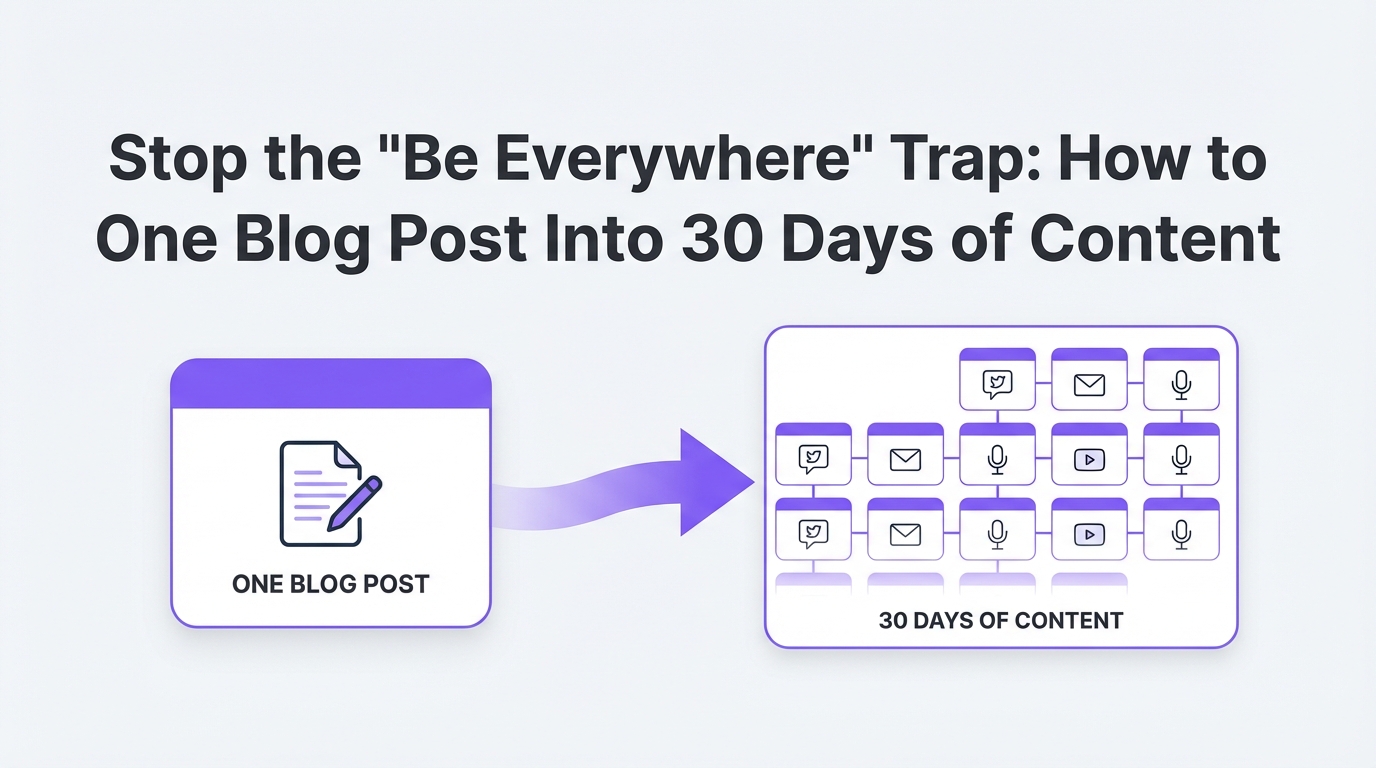
The "be everywhere" trap is one of the fastest ways to burn out as a business owner.
You’ve heard the drill: you need to be on LinkedIn to build authority, Instagram to show your personality, and Google to actually get found. It sounds great in theory, but you have an actual business to run. You aren't a full-time content creator, and you shouldn't have to be.
Most people view content marketing as a bottomless pit of time—a constant choice between serving clients or staring at a blinking cursor. But the most successful growth strategies aren't built on working harder; they’re built on content repurposing.
Repurposing is the ultimate leverage for experts. By creating one high-quality, SEO-driven "anchor" post, you can fuel an entire month of social media presence. Here is how to turn a single asset into a multichannel engine.
The "Core Asset" Strategy: Why Everything Starts with a Blog
If social media posts are the "quick wins" of marketing, blog posts are the "long-term investments."
A social media post has a shelf life of about 24 to 48 hours before it vanishes into the algorithm. A well-optimized blog post, however, works for you for years by capturing search traffic. This is why your blog should be your "Single Source of Truth."
When you start with a deep, helpful article on your website (often called a pillar page), you aren't just writing for Google; you’re creating a repository of ideas, quotes, and lessons that can be sliced and diced for every other platform.
Phase 1: Deconstructing the "Big Idea"
To get 30 days of content from one post, stop seeing the post as a single unit. Start seeing it as a collection of "micro-topics."
Let’s say you’ve written a 1,200-word post titled "5 Strategies for Scalable Growth in Professional Services." That post likely contains:
- The "Why": A compelling introduction that challenges the status quo.
- The "How": Five distinct, actionable strategy sections.
- The "Watch Out": Common mistakes or industry myths.
- The "Next Step": A concluding thought or call to action.
By breaking these down, you already have the foundation for at least 10–15 unique social updates.
Phase 2: The 30-Day Repurposing Roadmap
Repurposing allows you to be in multiple places at once without duplicating your effort. Here is a sample workflow for distributing that one blog post over four weeks:
Week 1: Establishing Authority
- Day 1 (LinkedIn/Facebook): Share the link to the full post with a "TL;DR" summary of the big idea.
- Day 3 (Instagram/X): Extract a "Power Quote"—a bold statement from your intro that stops the scroll.
- Day 5 (LinkedIn): A text-only post focusing exclusively on "Strategy #1." Go deep into the nuance.
Week 2: Educational Deep Dives
- Day 8 (Instagram Carousel): Turn your 5 strategies into a 5-slide visual guide. (Tools like Canva offer free carousel templates to make this quick).
- Day 10 (X Thread): Summarize the entire post into a 5-7 post thread.
- Day 12 (LinkedIn): Share a "Mistakes to Avoid" post based on the "What not to do" section of your blog.
Week 3: Multi-Media Engagement
- Day 15 (Reels/TikTok/Shorts): Film a 60-second video explaining just one specific point from the blog.
- Day 17 (Poll): Ask your audience which of the 5 strategies they find most difficult. Use your blog content to reply to the comments.
- Day 19 (LinkedIn/Facebook): Share a "Behind the Scenes" story about why you felt compelled to write about this topic.
Week 4: Reinforcement and Conversion
- Day 22 (Graphic): Create a simple checklist or infographic based on the "How-to" section.
- Day 24 (Q&A): Post a common question related to the topic and provide the answer you’ve already written in the post.
- Day 26 (Direct CTA): Remind your audience of the core problem your blog solves and link back to the article for those who missed it.
Removing the Friction of "What Do I Say?"
One of the biggest hurdles to consistency isn't a lack of knowledge—it's the friction of the daily "what should I post?"
Repurposing removes that decision fatigue. When you have a central blog post, your social media strategy transitions from creation to distribution. This ensures your brand message remains consistent. Whether a lead finds you on LinkedIn or Google, they see the same high-level expertise, which builds trust and shortens the sales cycle.
Leveraging AI to Close the Time Gap
Let’s be honest: even repurposing takes time. You still have to write the initial post, optimize it for SEO, and extract the snippets.
For the business owner who is already stretched thin, this is where automation becomes a competitive advantage. Platforms like Lexly are designed to bridge this gap. By using AI to generate high-quality, SEO-optimized blog posts, you handle the "Core Asset" creation in a fraction of the time.
Once the foundational blog post is live and working to improve your search rankings, turning it into a month of social content becomes a simple exercise in light editing rather than heavy lifting.
Take Back Your Time
You don’t need a 10-person marketing team to have a massive online presence. You just need a system that maximizes the ROI of every word you write.
By focusing on one deep, helpful blog post per month and strategically repurposing it, you maintain a consistent presence, build long-term SEO equity, and—most importantly—spend your time where it matters most: running your business.
Ready to automate your content foundation? See how Lexly can handle your blog strategy and SEO, so you can focus on growth.
Get actionable content marketing tips - straight to your inbox.
Join the Lexly newsletter for proven strategies, fresh content ideas, and AI marketing tips. No spam, just value.